The earnings calendar, who reports this week
On this page
Four times a year, public companies report how much they earned. The earnings calendar lists who reports on which day of the week, what analysts expect, and, once a company has reported, how the result compares with the expectation.
#Read the week
Open Earnings in the Finance section bar. The overview's Earnings today card lists today's reports.
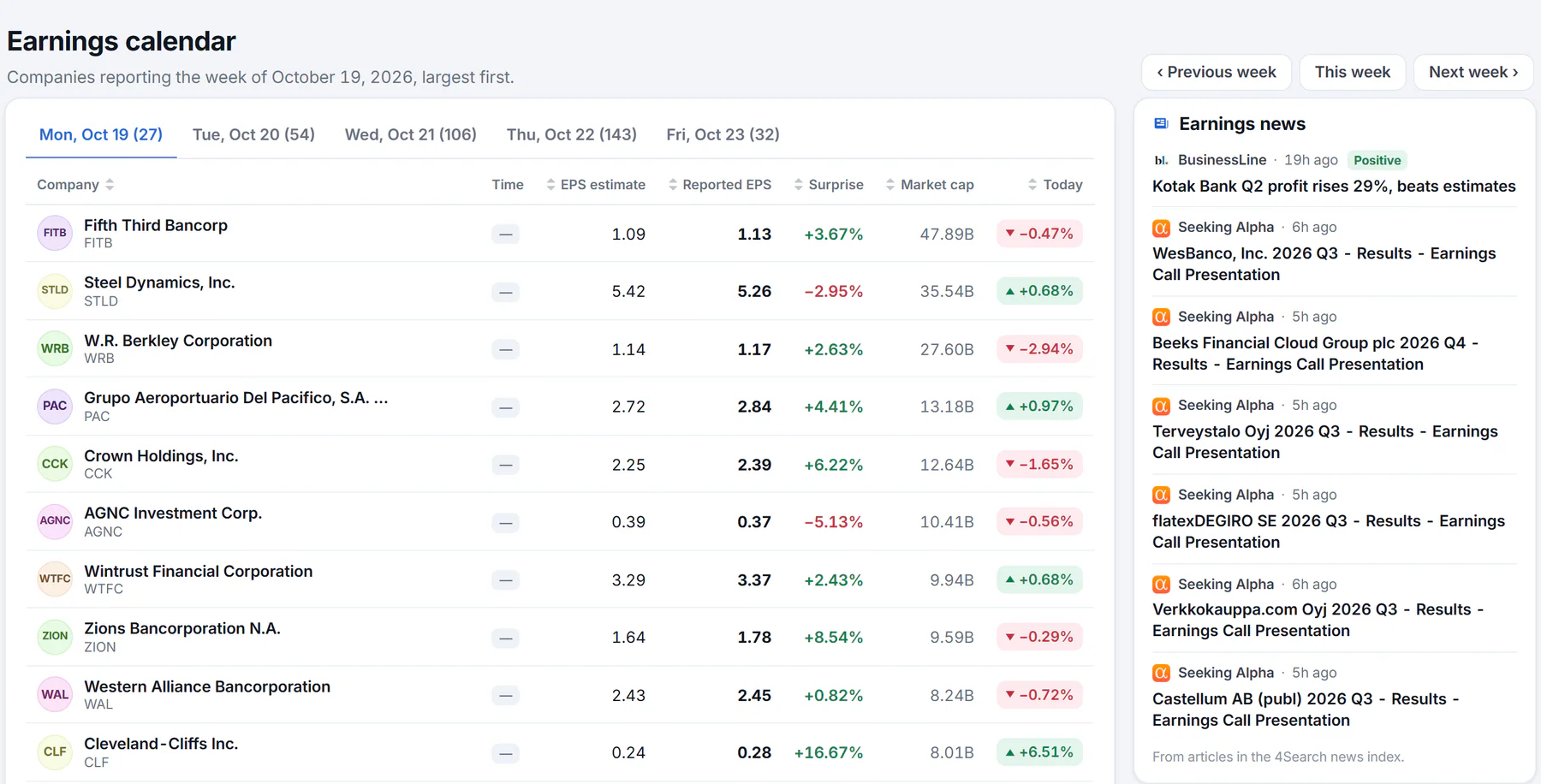
One tab for each trading day, with the number of companies reporting in brackets.
- 1Move between weeks
- 2One tab for each trading day
- 3Estimate, reported result and surprise
The page shows one week, Monday to Friday, with the largest companies first. Select a day's tab to see that day. Use Previous week, This week and Next week at the top right to move around. The calendar goes back and forward about four months.
The table has these columns:
| Column | Meaning |
|---|---|
| Company | The company and its ticker; select it to open its page |
| Time | Before open or After close shows when it reports; a dash means the time is not known |
| EPS estimate | What analysts expect the company to earn per share |
| Year-ago EPS | Last year's figure, for a day that has not reported yet |
| Reported EPS and Surprise | For a day that has reported: the actual result, and the percentage by which it beat (green) or missed (red) the estimate |
| Market cap | The size of the company |
| Today | The stock's move today |
Earnings per share, or EPS, is a company's profit divided by its number of shares. See Key statistics, explained.
A day with many reports shows the 60 largest, and a note says how many there are in all. A day with none says so.
Some rows carry a Beat label. It is the chance that prediction-market traders give the company of beating its estimate. It is the traders' odds, not a forecast by 4Search. See Prediction-market odds.
Times and estimates can change, and companies confirm their own dates; the page says so in a note. Earnings headlines are listed in Earnings news on the right.
#One company's dates
A stock's own page shows the next report in the Key statistics (Earnings date, with (est.) when the date is an estimate) and in the Earnings card, along with the last few quarters' results. See A stock's page and Research a company.
#Common questions
Why does a day show a different set of columns?
Before a company reports, the table shows last year's EPS for comparison. After it reports, the table replaces that with the actual result and the surprise.
Why is the time a dash?
The calendar has no time for that report, so it is not known whether it comes before the market opens or after it closes.
Is an earnings beat good news for the stock?
Not always. A stock can fall after a beat if investors hoped for more. The surprise only compares the result with the estimate.